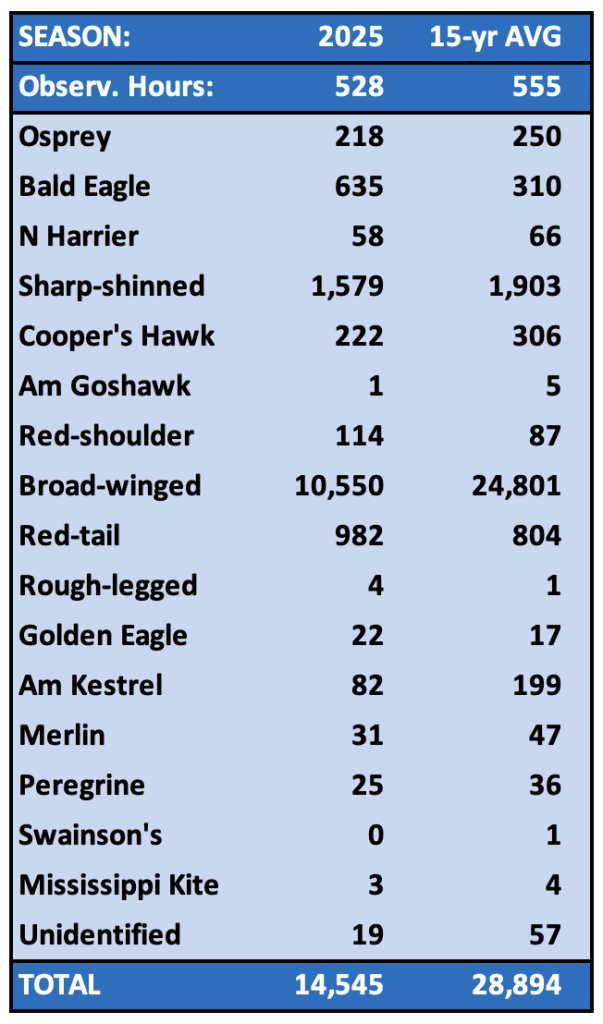
This year marked the 49th season of fall raptor migration at Rockfish Gap Hawk Watch; one of the longest running hawk watch sites in North America! Our small group of volunteer counters were able to cover 94 out of a possible 108 days of the season (15-year avg = 87 days) totaling 528 hours of effort (15-year avg = 555). Poor weather prevented the count on 11 days, and only 3 days went uncounted due to unavailability of counters. In total, we recorded 14,545 migrating raptors this season, which is quite below our 15-year average of 28,894 raptors. See accompanying table that summarizes our 2025 raptor numbers.
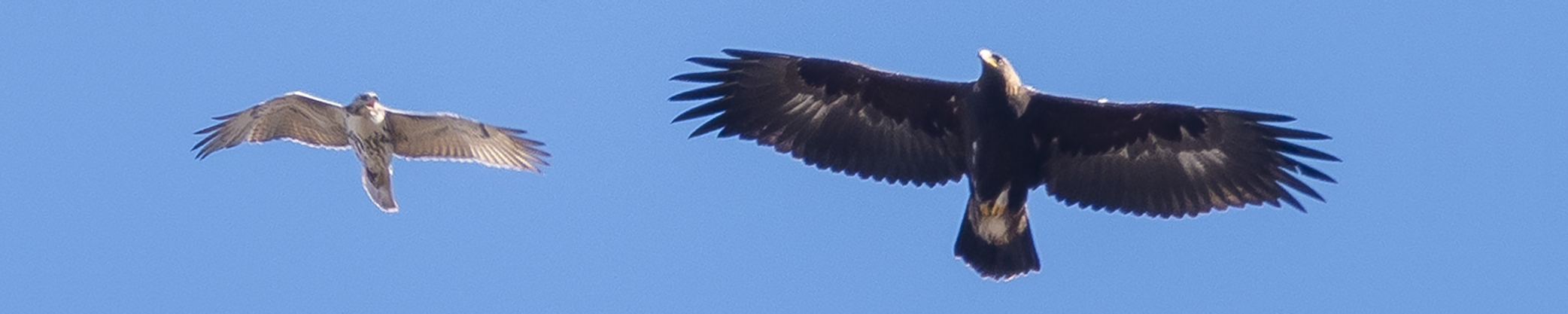
We had some surprising counts this year! Starting with the eagles, with 635 BALD EAGLES counted this season, we greatly surpassed the previous season record of 496 set last year (15-year avg = 310). The highest Bald Eagle day-count was 38 on 10/31, second only to 83 counted on 9/18/2018! Their numbers have been steadily climbing over the past 15 years. It is very interesting that of our 635 Bald Eagles, 509 were adults, which is a 4:1 ratio of adult to immature (immature defined as 1-4 years old). As for GOLDEN EAGLES, we ended with a total of 22 (15-year avg = 17), the highest count we’ve had since 2018 when we had 26. In fact, the last raptor counted this season was a Golden Eagle at 2:40pm on Nov 29. We had 4 multiple-Golden Eagle days this season (2 on 10/1, 11/14, 11/16, and 5 on 11/28).
The OSPREY count of 218 this year was a little below average (15-yr avg = 250), and the NORTHERN HARRIER count of 58 was also a little below average (15-yr avg = 66). We had 3 MISSISSIPPI KITES this season (15-yr avg = 4), which brings us to 10 years of continuous Mississippi Kite sightings at Rockfish Gap! No Swallow-tailed Kites were sighted however.
Our count of 1,579 SHARP-SHINNED HAWKS was a little below average (15-yr avg = 1,903). Similarly, our count of 222 COOPER’S HAWKS was below average (15-yr avg = 306). However, it was quite a nice surprise to have seen an AMERICAN GOSHAWK on Nov 27 (15-yr avg = 5). Their numbers have been decreasing over recent years, with none observed in the previous 2 years.
Among the buteos, our count of 982 RED-TAILED HAWKS was well above average (15-yr avg = 804). Here, we had a steady flow of single digit daily counts through October, which picked up to double-digit daily counts throughout November. The highest Red-tailed Hawk day was 105 on Oct 31. We were nicely surprised with a count of 114 RED-SHOULDERED HAWKS, which was above average (15-yr avg = 87). In fact, our count of 24 Red-shouldered Hawks on Nov 27 broke our previous single-day record of 23 on 10/31/2016! The BROAD-WINGED HAWK count of 10,550 this year was less than half of average (15-yr avg = 24,801)! We only had 3 days with greater than a thousand Broad-wings (2,020 on Sep 18, 2,742 on Sep 19, 2,157 on Oct 1). The most likely explanation seems to be poor weather that was not conducive to the typical big flight down the Blue Ridge through Rockfish Gap; largely due to Atlantic Ocean storms that brought in predominantly northeast winds across the mid-Atlantic. Finally, we were quite surprised to see 4 migrating ROUGH-LEGGED HAWKS this year (all light morph, 2 each on Nov 27 and 28)! This is a new season record, beating 3 observed in 2020. Nov 27 and 28 were quite productive due to a big cold front that moved through with high northwest winds and clouds resulting in many migrants including: a late Osprey, 26 Bald Eagles, an American Goshawk, 100 Red-tails, 6 Golden Eagles, a Merlin, Canada Geese, Snow Geese, Tundra Swans, Cormorants, Ring-necked Ducks, Gulls, and Common Loons.
All of the falcons were below average this season. We counted only 82 AMERICAN KESTRELS (15-yr avg = 199), 31 MERLIN (15-yr avg = 47), and 25 PEREGRINE FALCON (15-yr avg = 36).
In terms of non-raptors, the season’s Monarch butterfly numbers bounced back from a low of 143 last year to 860 this year (10-yr avg = 1,439). We also counted 68 Ruby-throated Hummingbirds and 44 Red-headed Woodpecker. We had a lot of other interesting migrants including: 2 Cave Swallows on Nov 10, 404 Double-crested Cormorants, 77 Tundra Swan, 55 Canada Geese, 54 Snow Geese, 6 Common Loon, 55 Ring-necked Duck, 68 Ring-billed Gull, 3 American Herring Gull, and 13 Sandhill Crane (4 on 9/29, 5 on 10/1, 4 on 11/23). We had a nice warbler flight of 19 species including: Cape May, Common Yellowthroat, Palm, Prairie, Black-throated Green, Black-throated Blue, Magnolia, Connecticut, Blackpoll, Parula, Blackburnian, Chestnut-sided, Redstart, Kentucky, Tennessee, Bay-breasted, Blue-winged, Yellow-rumped, and Orange-crowned.
The Spotted Lanternflies were quite horrible this year (worse than last year)! They often filled the skies, making it difficult to scan for raptors, and they covered the building, sidewalk, and grounds. On warm September days it was common to have a dozen or more covering one’s spotting scope and everything else! We again did not have our annual Open House event this year due to the poor conditions of the Inn, parking lot and access. The future of this site still remains unknown.
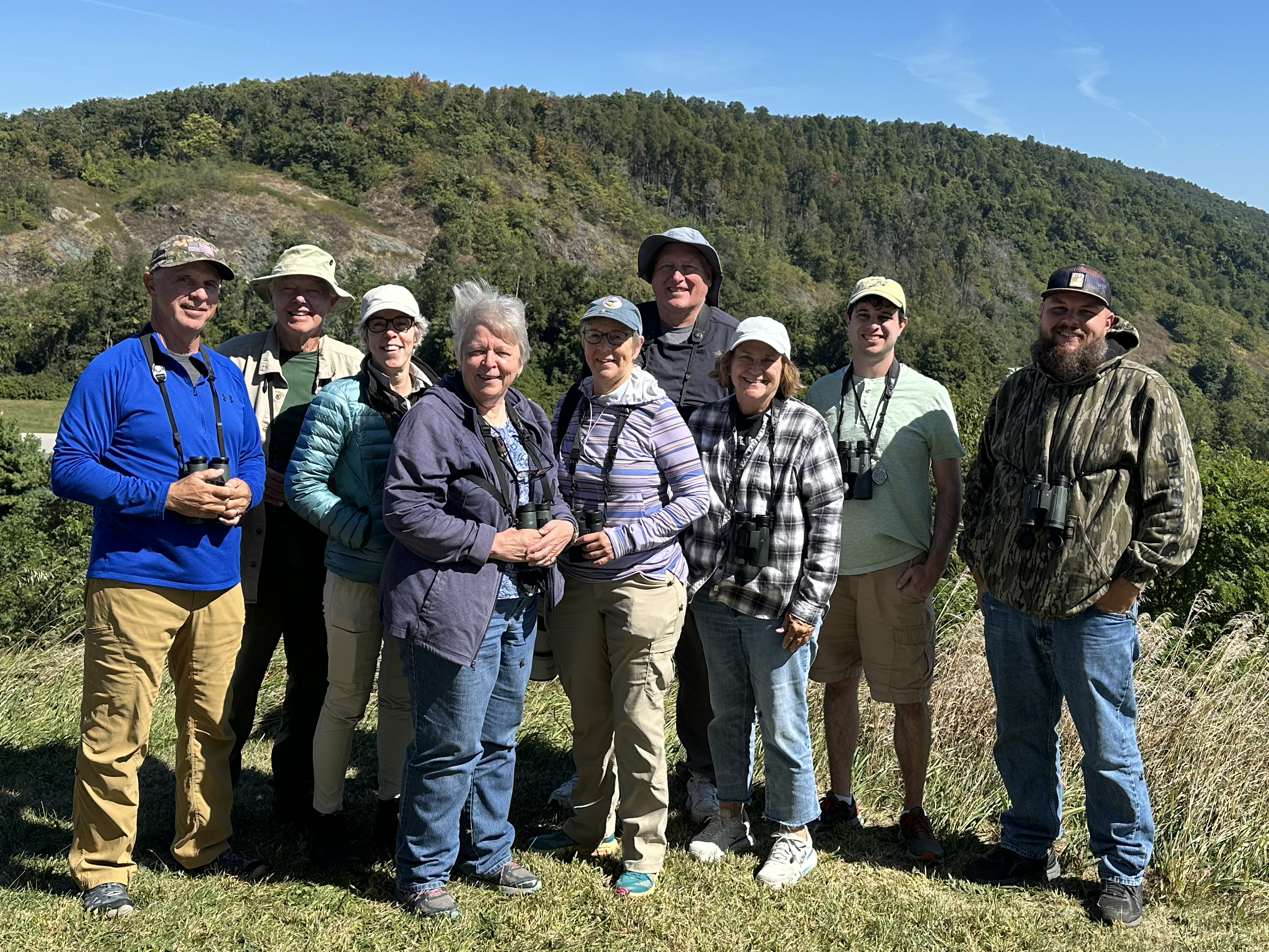
I give a huge thanks to the following volunteers who contributed this season as counters: Rose Thomas, David Hunter, Gabriel Mapel, Josh Laubach, William Leigh, Justin Cober-Lake, Matt Hosmer, and Dave Fischer. Another huge thanks goes to the many Observers who helped scan that huge sky! It was wonderful to have had so many visitors this season who stopped by to keep us company and to witness the great fall raptor migration! Finally, we thank all those who helped support our hawk watch this year with your generous donations!
– Vic Laubach, Coordinator